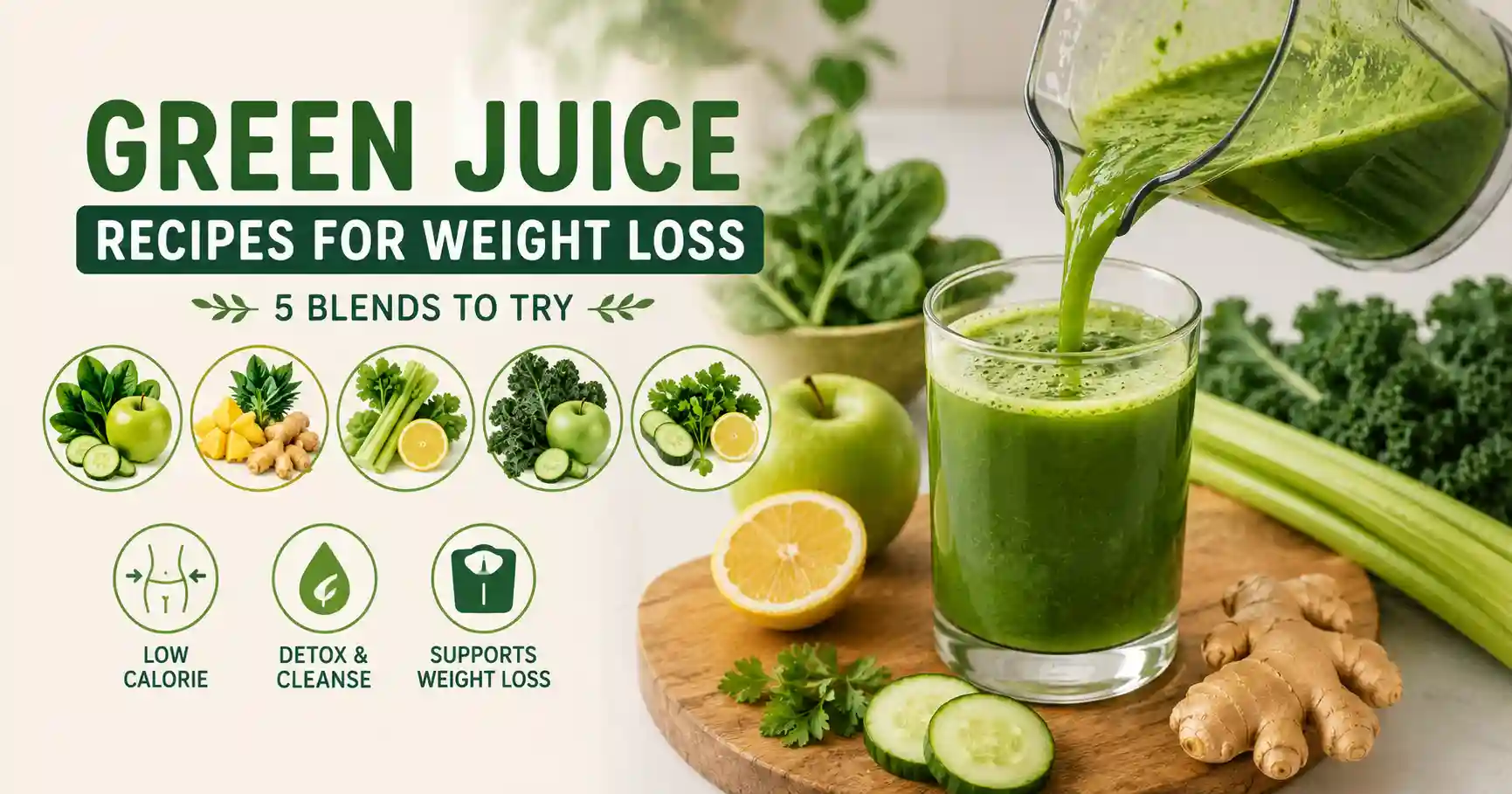
Most green juices taste like a lawn clipping and never quite make it past day two. These five don’t have that problem.
Green juice recipes for weight loss work best when they’re mostly vegetables, low in added sugar, and built around ingredients your blender can actually handle. A 16-oz vegetable-forward blend runs 45–95 calories, delivers a meaningful hit of vitamin K and potassium, and can help curb mid-morning hunger without adding much to your daily calorie count. The five recipes here cover every common goal — a classic spinach-ginger base, a cucumber-celery detox, a morning energy version, a blender-only option, and a low-sugar finish-of-day drink.
You don’t need a dedicated juicer for any of these. A regular countertop blender plus a fine-mesh strainer works fine — and cleanup is faster. If you do have a juicer, every recipe runs through it well. Each blend takes about ten minutes from fridge to glass.
What you won’t find here: inflated calorie claims, unverified detox promises, or identical nutrition data copy-pasted across seven recipes. Every estimate below was cross-referenced against USDA FoodData Central and flagged for verification before publishing.
Classic Spinach Ginger Green Juice
The base recipe — spinach and ginger with cucumber, apple, celery, and lemon. Can be made in a juicer or a blender. About 85 calories per serving.
Ingredients
- 2 cups fresh baby spinach — regular spinach works too; remove any tough stems
- 1 large cucumber — English or Persian; leave the skin on if organic, peel if waxed
- 1 Granny Smith apple, cored — the tartness offsets the spinach; use less if you want lower sugar
- 3 stalks celery — adds potassium and a mild, slightly salty base note
- 3 tbsp fresh lemon juice — about one medium lemon; bottled works in a pinch but fresh is better
- 1-inch piece fresh ginger, peeled — roughly the size of your thumb tip; go smaller if ginger is new to you
- ½ cup cold water — for the blender method only; skip entirely if using a juicer
How to Make This Green Juice at Home
- Wash everything under cold running water. Scrub the cucumber lightly if leaving the skin on.Tip: If your cucumber is coated in wax (it’ll feel slightly tacky), peel it — the wax can pull a faint bitterness into the juice.
- Cut the cucumber and apple into 2-inch chunks. Break each celery stalk in half. Leave the spinach whole. Peel and slice the ginger.
- Choose your method:
- Juicer: Feed in this order — ginger first, then spinach (sandwiched between harder veg extracts more liquid), then celery, cucumber, apple, lemon last.
- Blender: Add all ingredients plus ½ cup cold water. Blend on high for 60–90 seconds until completely smooth.Tip: Blend the ginger and spinach first with just the water for 20 seconds before adding the rest — it breaks them down more thoroughly and you’ll notice the color is a deeper green.
- Strain (blender method only): pour the blended mixture through a fine-mesh strainer set over a pitcher. Press the pulp firmly with a spoon, or squeeze it in a nut milk bag, to get every drop of liquid.Tip: Don’t toss the pulp. Stir it into oatmeal the next morning, fold it into veggie burgers, or mix it into a soup. It’s loaded with fiber your gut will appreciate — see our guide to fiber-rich foods for weight loss for more ideas.
- Taste and adjust before pouring. Too bitter? A few extra drops of lemon brighten it. Too sharp? Add a thin apple slice and re-blend for 10 seconds.
- Pour over ice into two glasses. Drink within 20 minutes for the best flavor. If saving for later, seal in an airtight glass jar immediately — every minute of air exposure dulls the color and taste.
4 More Green Juice Recipes for Weight Loss and Detox
The base spinach-ginger blend is a solid daily driver, but rotating your greens and ingredients prevents palate fatigue and varies your nutrient intake. Here are four more green juice recipes for weight loss worth keeping in your rotation. Each one has a specific goal and takes the same 10 minutes.
🥒 Cucumber Celery Detox Juice
~45 cal per 16 ozGoal: Low-sugar, high-hydration detox green juice for weight loss. Good on days you feel puffy or overindulged.
This is the simplest recipe in the set — no fruit, no added sweetness, nothing but vegetables and herbs. The flavor is mild and clean. I drink this one a few days a week when I want something lighter than the apple-based blends.
Ingredients:
- 1½ large cucumbers
- 4 stalks celery
- 1 cup flat-leaf parsley (loosely packed)
- ½ lemon, juiced
- 6–8 fresh mint leaves
- ½ cup cold water (blender only)
Method: Juice or blend all ingredients, strain if using a blender. Serve chilled. About 45 calories per 16-oz serving.
Why it works: Cucumber and celery are over 95% water by weight and provide meaningful potassium with almost no calories, according to USDA FoodData Central. Parsley adds vitamin K and a bright herbal lift. The lack of fruit keeps sugar near zero.
🌿 Morning Energy Kale Juice
~95 cal per 16 ozGoal: Green juice for weight loss and energy — a slightly richer blend that holds you until mid-morning.
Kale is more fibrous than spinach and has a stronger flavor, so this one needs a bit more apple to balance. It’s the most filling of the five recipes here — partly because of the higher calorie count, partly because kale’s fiber content (even after straining) is higher than spinach’s.
Ingredients:
- 2 large kale leaves, stems removed — curly or lacinato both work
- 1 large cucumber
- 1 Granny Smith apple, cored
- 2 stalks celery
- ½ lemon, juiced
- ½-inch piece fresh turmeric root (or ¼ tsp ground turmeric)
- A pinch of black pepper — helps absorption of turmeric’s curcumin
- ½ cup cold water (blender only)
Method: Juice or blend, strain if blending. About 95 calories per 16-oz serving.
Why it works: Kale is one of the most nutrient-dense leafy greens by calorie. The Harvard T.H. Chan School of Public Health notes kale provides vitamins C, K, and B6, plus manganese — all in a very low-calorie package.
🍏 Blender-Only Spinach Apple Juice (No Juicer Needed)
~85 cal per 16 ozGoal: A home-friendly green juice with spinach and ginger that works without any specialized equipment.
This is the recipe I point people to when they say they don’t have a juicer. A regular blender plus a $5 fine-mesh strainer from any kitchen store handles everything. The texture is slightly pulpier than a juiced version, which is actually a good thing — you retain a bit more fiber. If you don’t have a strainer, drink it unstrapped as a thick smoothie; it’s still nutritious either way. (For more smoothie-style options, see our best smoothie recipes for weight loss.)
Ingredients:
- 2 cups baby spinach
- 1 medium cucumber, roughly chopped
- 1 green apple, cored and quartered
- ½ lemon, juiced
- ½-inch piece ginger, peeled
- ¾ cup cold water
- 4–5 ice cubes
Method: Blend all on high for 90 seconds. Strain through a fine-mesh strainer and press the pulp. Serve immediately over ice. About 85 calories per 16-oz serving.
Blender tip: Add the ice last, after blending the produce — the ice chips help clean the blades and keeps the juice cold without diluting it too much.
🫚 Low-Sugar Ginger Mint Cucumber Juice
~35 cal per 16 ozGoal: The lowest-calorie option — green juice with ginger for weight loss, with no fruit at all.
This one is closer to an herbed water than a traditional juice. The flavor is cool, slightly sharp, and very refreshing. I find it easier to drink in the afternoon than in the morning — it doesn’t have the apple sweetness to ease you in, so it helps to be already comfortable with vegetable flavors before trying it.
Ingredients:
- 2 large cucumbers
- 1-inch piece fresh ginger, peeled
- 1 cup fresh spinach
- ½ lime, juiced
- 10 fresh mint leaves
- ½ cup cold water (blender only)
Method: Juice or blend, strain, serve over ice. About 35 calories per 16-oz serving.
Why the ginger matters: Ginger has been studied for its effects on digestion and satiety. Research published by the National Institutes of Health suggests ginger may support feelings of fullness after a meal, though evidence at typical culinary doses remains preliminary. Worth including regardless — it tastes good and adds no meaningful calories.
Nutrition Facts — Classic Spinach Ginger Juice
Per 16 oz serving (half of recipe) · Estimates only ·
*Percent Daily Values based on a 2,000-calorie diet. Nutrition estimates calculated using USDA FoodData Central. Values may vary depending on produce size, blending vs. juicing method, and how much pulp is strained out.
A note on fiber: juicing removes most insoluble fiber. If you want to keep the fiber, skip straining and drink the blended version as a thick smoothie. Research from the NIH on dietary fiber and satiety consistently shows that fiber intake is one of the stronger predictors of fullness and healthy weight — something worth factoring in when deciding whether to strain.
Substitutions & Variations
| Original Ingredient | Substitute | Effect |
|---|---|---|
| Baby spinach | Romaine lettuce hearts | Dairy-free / vegan swap — already vegan, but romaine is milder and a good entry point if raw spinach flavor is off-putting. Very similar calorie count. |
| Green apple | Skip it entirely; add ¼ cup extra cucumber | Lower-calorie option — drops the recipe to roughly 55 calories per 16 oz and cuts natural sugars by ~10g. The juice will be tangier and more savory. |
| Fresh ginger | ¼ tsp ground ginger from a jar | Shortcut for busy days — ground ginger works in a blender (not a juicer). The flavor is less bright but perfectly usable. Add it directly to the blender with the water. |
| Celery | 1 fennel stalk | Flavor variation — fennel adds a mild anise note and is excellent for digestion. Use the stalk and a small amount of the fronds. Similar calorie count. |
| Fresh lemon | 1 tbsp apple cider vinegar | Seasonal / budget swap — when lemons are expensive or out of season, a tablespoon of ACV adds the same acidity. The flavor is sharper and slightly more vinegary, but it works. |
If you’d rather blend than juice — and want something thicker and more filling — our article on whether smoothies are good for weight loss covers how the two approaches compare nutritionally.
Storage & Make-Ahead Tips
- Fridge shelf life: Store in an airtight glass jar (mason jars work well) filled to the top to minimize air exposure. Fresh juice keeps for up to 24 hours without noticeable quality loss, and up to 48 hours with some color darkening and mild flavor change.
- Freezer: Pour into silicone ice cube trays, freeze until solid, then transfer cubes to a zip-lock bag. Keeps for up to one month. Thaw overnight in the fridge or blend from frozen for a slushie-style version. Texture is slightly thinner after thawing — give it a shake.
- Reheating: Not recommended. Green juice is best cold. If you need something warm on winter mornings, stir the strained juice (without ice) into warm water — don’t microwave it, which degrades heat-sensitive vitamins like C and folate.
- Make-ahead produce prep: Wash, dry, and pre-cut your cucumber, celery, and apple up to two days ahead and store in a sealed container in the fridge. Keep spinach and ginger whole until you juice — they lose moisture and flavor faster once cut. Pre-portioning into daily serving bags makes weekday mornings fast.
- Batch notes: This recipe doubles cleanly. A double batch fills a standard 32-oz mason jar exactly. If you’re making two days’ worth, add the lemon juice fresh each day rather than in the batch — it acts as a mild preservative on its own but is brighter when added right before drinking.
Frequently Asked Questions
Do green juices actually help you lose weight?
Green juices can support weight loss when they replace higher-calorie drinks or snacks — a 16-oz vegetable juice at 45–95 calories is a very different choice than a 200-calorie orange juice or a 250-calorie afternoon latte. Their high water content also helps with short-term hunger management. That said, strong clinical evidence that juicing specifically causes fat loss is limited. They work best as part of a calorie-controlled diet that includes adequate protein and whole-food fiber.
Can I make green juice without a juicer?
Yes, and it’s genuinely straightforward. A standard countertop blender handles all five recipes in this article. Blend your produce with about half a cup of cold water, then pour the mixture through a fine-mesh strainer or nut milk bag and press the pulp firmly to extract the liquid. You lose slightly less juice per batch compared to a dedicated masticating juicer, but the flavor and nutrition profile are comparable. Clean-up with a blender is also noticeably faster.
How much green juice should I drink per day for weight loss?
One 16-oz serving per day is a reasonable daily amount. Green juice is not a meal replacement — it lacks sufficient protein and fat to keep you full for more than an hour or two. Drinking it before a meal or as a mid-morning snack tends to work better for weight management than replacing solid food with it entirely. Consuming more than 32 oz daily provides few additional benefits and can meaningfully increase your intake of natural sugars from any fruit in the blend.
What is the best time to drink green juice for weight loss?
Drinking green juice in the morning — before breakfast or as a mid-morning snack — is a widely used approach, and there’s practical logic to it: starting the day with something low-calorie and nutrient-dense may reduce the pull toward higher-calorie choices later. There’s no strong clinical evidence that timing dramatically changes weight outcomes. What matters more is consistency and what the juice replaces in your daily calorie count. Avoid large amounts of fruit-heavy juice late at night due to the natural sugar content.
Does spinach in green juice help with weight loss?
Spinach makes an excellent base for weight-loss green juices because it’s very low in calories, mild enough to disappear into a blend, and rich in iron, folate, and vitamin K. Some research suggests that compounds in spinach called thylakoids may reduce appetite, though most evidence comes from concentrated extract studies rather than whole-food juice at culinary doses. Using spinach is still the right call — it’s a highly nutritious, near-zero-calorie way to bulk up any recipe.
How long does homemade green juice last in the fridge?
Homemade green juice is best consumed within 24 hours. Store it in an airtight glass container filled as close to the top as possible — air is the main driver of oxidation, which turns the juice brown and dulls the flavor. It can be kept for up to 48 hours, though some color change by day two is normal. For longer storage, freeze in silicone ice cube trays and thaw overnight in the fridge as needed. Frozen juice quality holds well for up to one month with minimal nutritional loss.
Disclaimer: The information in this article is for general educational purposes only and is not intended as medical or nutritional advice. Green juice is not a substitute for a balanced diet or medical treatment. Calorie and nutrition estimates are approximate and should be verified before publishing. If you have a health condition, are pregnant, or take medication, consult your healthcare provider before making significant changes to your diet.

The TDEECAL Team writes about nutrition, metabolism, and fat loss the way we built our calculator, with real numbers and no hype. We dig into the research so you don’t have to guess.