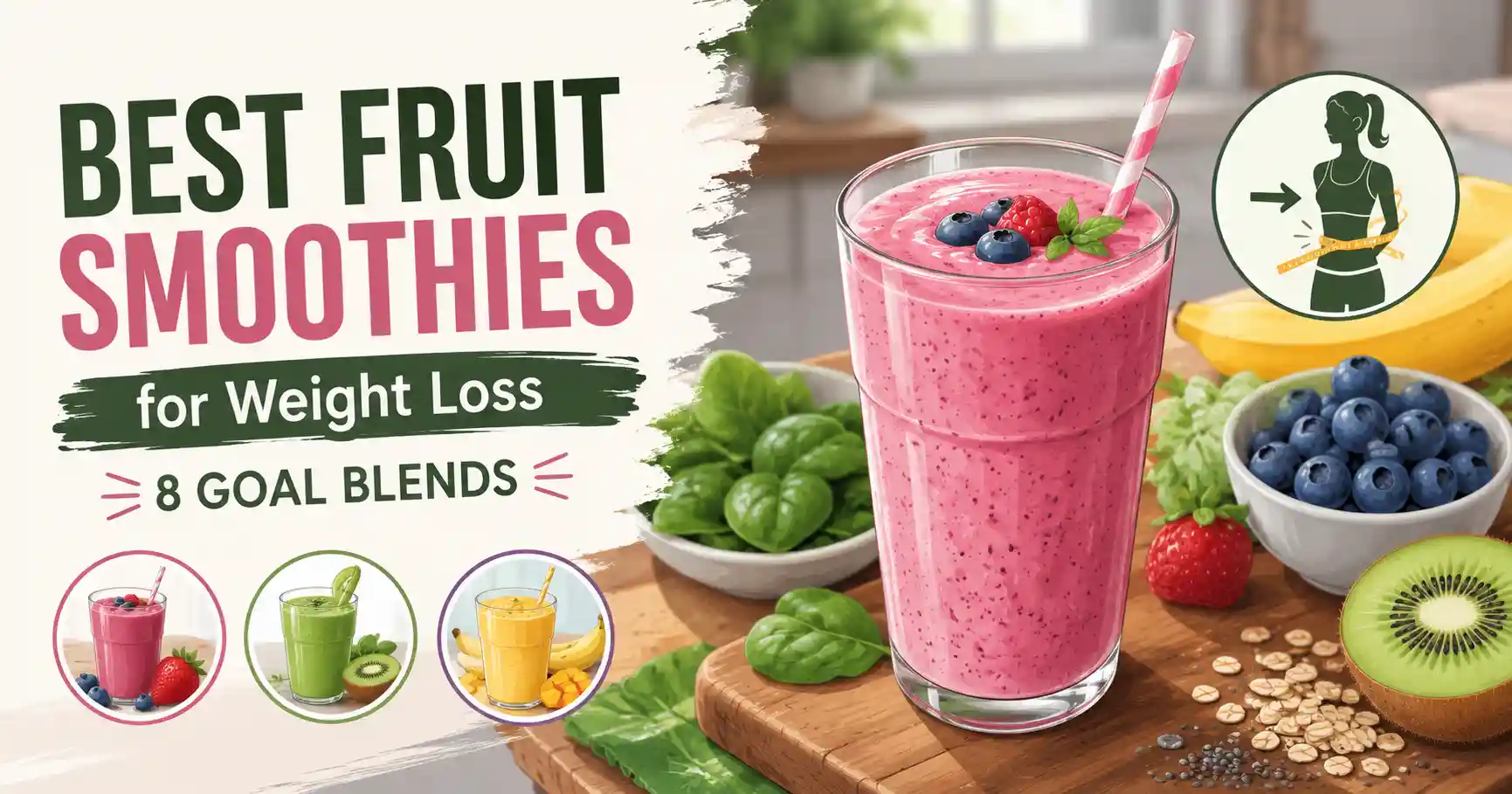
Most people don’t need more smoothie recipes. They need the right ones.
The best fruit smoothie recipes for weight loss are the ones that keep you full for two to three hours, stay under 300 calories, and actually taste worth repeating. This guide gives you 8 of them — organized by goal, with real calorie estimates and ingredients you likely already have. No protein powder required for most.
If you’ve blended a smoothie that left you hungry an hour later, the problem is almost always structure. Too much fruit sugar, not enough protein or fiber. Every recipe here has at least 5 grams of fiber, at least 10 grams of protein, or both. That combination is what separates a smoothie that works from one that just tastes like dessert.
Whether you want more energy in the morning, better skin, less belly bloat, or a post-workout recovery option — there is a recipe below built for your specific goal. And if you want to understand how smoothies affect weight loss before you start blending, that guide covers the evidence plainly.
Featured Recipe: Mixed Berry Weight Loss Smoothie
Mixed Berry Weight Loss Smoothie
This is the all-purpose starting point — roughly 275 calories, 14 grams of protein, and 10 grams of fiber. It works as a full breakfast replacement and holds most people over until lunch without a mid-morning snack.
Ingredients
- 1 cup frozen mixed berries — strawberries, blueberries, and raspberries; pre-mixed bags cost less than buying each separately and work identically
- ½ medium banana, frozen — freeze ripe bananas in halves before they go over; this adds creaminess without added sugar and removes the need for ice
- ¾ cup unsweetened almond milk — about 25–30 calories per cup; oat milk works but adds roughly 60 extra calories per serving
- ½ cup plain nonfat Greek yogurt — the main protein source; contributes approximately 11g of protein per half cup
- 1 tablespoon chia seeds — adds ~5g fiber and ~2g protein; find them in the health food or baking aisle
- ½ teaspoon ground cinnamon — mild blood sugar stabilizer; not required but worth including
- ½ cup ice — optional if you are using all frozen fruit
Step-by-Step Instructions
-
Pour the almond milk into the blender first. This protects the blades when frozen ingredients land on top and gives the motor something to pull through immediately.Tip: Always add liquid before frozen fruit. Starting on medium speed for the first 10 seconds before switching to high reduces strain on lower-powered blenders.
- Add the Greek yogurt, chia seeds, and cinnamon directly on top of the liquid.
- Place the frozen mixed berries and banana half on top of the yogurt layer.
-
Blend on high speed for 45 to 60 seconds. Stop when the smoothie is fully smooth with no visible fruit pieces remaining.Tip: If the blender stalls or struggles, stop and add 2 tablespoons of almond milk, then restart on low before switching to high. Never force the motor.
- Check the consistency. If it is thicker than you like, add one tablespoon of almond milk at a time and blend for 5 seconds. If you want it slightly sweeter, a small drizzle of honey adds about 20 calories.
- Pour immediately into a glass and drink within 15 minutes. Chia seeds absorb liquid and the texture shifts noticeably if the smoothie sits longer.
7 More Fruit Smoothie Recipes for Weight Loss by Goal
The mixed berry smoothie above is the reliable daily option. These seven recipes are organized by the specific goal most readers describe in their searches — energy, muscle support, glowing skin, detox, belly fat, satiety, and pre-workout. Each one is built around a calorie target and a dominant nutrient that earns its place.
If building muscle alongside cutting fat is your priority, the banana protein smoothie below is a good starting point. TDEEcal’s full guide to high-protein smoothie options without protein powder covers the subject in more depth for those who want to go further.
2. Pineapple Ginger Metabolism Smoothie
Goal: Morning energy · Reduced bloating · Fat burning smoothies for weight loss
- 1 cup frozen pineapple chunks
- ½ cup unsweetened coconut water
- ½ cup plain nonfat Greek yogurt
- ½-inch piece fresh ginger, peeled (or ¼ tsp ground ginger)
- ½ tsp ground turmeric
- 1 tsp honey (optional)
- ½ cup ice
Pineapple contains bromelain, an enzyme frequently associated with reduced gut inflammation and bloating. The clinical evidence for direct fat reduction is still limited — but as a low-calorie, high-volume option that holds up well at 7 AM, it works in practice. Fresh ginger makes a noticeably sharper bite here versus ground ginger; use it if you have it.
How to blend: Add coconut water and yogurt to the blender first, then remaining ingredients. Blend 45 seconds on high.
3. Spinach Apple Detox Smoothie
Goal: Digestive reset · Low-calorie day · Detox & cleanse
- 1 cup baby spinach (fresh or frozen)
- 1 medium green apple, cored and roughly chopped
- ½ cup cucumber, roughly chopped
- Juice of ½ lemon
- ½ cup unsweetened almond milk
- 1 tbsp ground flaxseed
- ½ cup ice
Spinach has almost no detectable flavor when blended with apple and lemon, so this reads as a bright, tart green smoothie rather than a vegetable drink. The word “detox” gets overused in food writing — your liver handles actual detoxification. What this recipe does well is stay under 200 calories while providing real fiber through the flaxseed and apple skin. I add an extra squeeze of lemon when I want it crisper.
How to blend: Add almond milk and spinach first, blend 45–60 seconds to fully break down the leaves, then add remaining ingredients and blend 30 more seconds.
4. Banana Greek Yogurt Protein Smoothie
Goal: Weight loss + muscle gain · Post-workout recovery · Protein fruit smoothie for weight loss
- 1 medium banana, frozen
- ¾ cup plain nonfat Greek yogurt
- 1 tbsp natural almond butter (no added sugar)
- ¾ cup unsweetened almond milk
- 1 tbsp chia seeds
- ½ tsp vanilla extract
At roughly 310 calories and around 20 grams of protein, this functions as a post-workout meal rather than a light snack. The banana provides quick carbohydrates for muscle glycogen replenishment after training, while the Greek yogurt and almond butter supply the protein and fat needed for recovery. Count it as a full meal — not a snack on top of breakfast.
How to blend: All ingredients together, 45–60 seconds on high. This blends thick — add almond milk one tablespoon at a time if needed.
5. Mango Carrot Skin Glow Smoothie
Goal: Weight loss + glowing skin · Vitamin A & C boost
- ¾ cup frozen mango chunks
- 1 medium carrot, peeled and roughly chopped
- ½ cup plain nonfat Greek yogurt
- ½ cup unsweetened almond milk
- Juice of ½ orange
- ¼ tsp ground turmeric
- ½ cup ice
Mango and carrot are both rich in beta-carotene, which the body converts to Vitamin A — a nutrient involved in skin cell turnover. The orange juice adds Vitamin C, which plays a documented role in collagen synthesis according to the NIH Office of Dietary Supplements. Give carrot a full 60-second blend before adding other ingredients — it needs more time than fruit to fully integrate.
How to blend: Blend almond milk and carrot first for 45 seconds, then add remaining ingredients and blend 30 more seconds.
6. Watermelon Mint Hydration Smoothie
Goal: Belly fat · Reduce water retention · Light afternoon option
- 2 cups seedless watermelon, cubed and frozen
- ½ cup cucumber, roughly chopped
- 6–8 fresh mint leaves
- Juice of ½ lime
- ¼ cup water or coconut water
Watermelon is roughly 92% water, which makes this the lightest option on the list by calorie count. It will not keep most people full for three hours — it is best used as a mid-afternoon option when you need something between meals without a meaningful caloric cost. The mint and lime combination makes it actually refreshing rather than simply sweet. No yogurt, no protein powder — this one is about volume and hydration.
How to blend: All ingredients together, 30–45 seconds. Watermelon blends quickly and does not need high sustained speed.
7. Peach Chia Fiber Smoothie
Goal: Sustained satiety · Digestive health · Steady energy
- 1 cup frozen peach slices
- ½ medium banana, frozen
- ½ cup plain nonfat Greek yogurt
- ¾ cup unsweetened almond milk
- 1 tbsp chia seeds
- 1 tbsp ground flaxseed
- ¼ tsp ground ginger
Chia and flaxseed together deliver close to 8 grams of fiber in one serving. Harvard T.H. Chan School of Public Health notes that dietary fiber slows gastric emptying, which is the primary mechanism behind sustained fullness after a high-fiber meal. This smoothie keeps most people satisfied for three to four hours. Let it sit for two minutes before drinking — the chia thickens it slightly in a good way.
How to blend: All ingredients, 45–60 seconds on high. The texture is thicker than the other recipes; add extra milk if you prefer a thinner consistency.
8. Strawberry Beet Energy Smoothie
Goal: Pre-workout energy · Antioxidants · Weight loss + energy
- 1 cup frozen strawberries
- ¼ cup cooked beet, roughly chopped (or 2 tbsp beet powder)
- ½ cup plain nonfat Greek yogurt
- ¾ cup unsweetened almond milk
- 1 tsp honey
- ½ cup ice
Beet is the ingredient most people skip because it sounds strange — but the flavor is almost undetectable behind strawberry, and the color is striking. Dietary nitrates in beets have been studied for effects on exercise endurance, with research indexed on PubMed Central suggesting potential benefits for cardiovascular performance. Drink this 30–45 minutes before a workout for best effect. Pre-cooked beet from a vacuum-sealed pouch (available at most grocery stores) saves the roasting step entirely.
How to blend: All ingredients, 60 seconds on high. Beet needs a full blend to integrate without leaving grainy bits.
Nutrition Facts Per Serving
Nutrition Facts
Mixed Berry Weight Loss Smoothie · Per serving (1 smoothie, ~16 oz) · Serves 1
Nutrition estimates calculated using USDA FoodData Central data. Values may vary by brand, exact fruit variety, or ingredient substitution.
The 24g of sugar looks high at a glance, but every gram comes from the fruit and yogurt — there is no added sugar in this recipe. According to USDA FoodData Central, one cup of frozen mixed berries contains roughly 12–15g of natural sugar alongside 3–4g of fiber, which significantly slows the rate of sugar absorption compared to a sugar-only source. That is a meaningfully different metabolic situation than 24g of added sugar in a soda or juice.
If you are comparing smoothies to shakes, TDEEcal’s breakdown of meal replacement shakes for weight loss is worth reading — it covers when a shake outperforms a whole-food smoothie and when it does not.
Substitutions & Variations
| If you want to… | Swap or change this |
|---|---|
| Make it dairy-free or vegan | Replace the Greek yogurt with plain coconut yogurt or silken tofu (½ cup). Protein drops to roughly 6–8g per serving. Unsweetened soy milk instead of almond milk adds ~3g extra protein. |
| Cut calories below 200 | Remove the banana and reduce berries to ¾ cup. Swap almond milk for water. This removes roughly 80–90 calories and keeps fiber and protein largely intact. |
| Save time on busy mornings | Pre-portion smoothie freezer packs: place one serving of frozen fruit, chia seeds, and cinnamon in a zip-lock bag. On the morning, empty the bag into the blender, add yogurt and milk, and blend. No measuring, no cleanup decisions. |
| Try a flavor variation | Swap berries for frozen cherries and add ½ tsp cocoa powder for a chocolate cherry version (~285 cal). Or use frozen mango with lime juice for a tropical take. Both work with the same yogurt and chia base. |
| Increase protein without powder | Add 2 tbsp hemp seeds (~6g extra protein, ~110 extra calories) or increase Greek yogurt to ¾ cup. Both work without changing the texture significantly. |
| Budget swap | Store-brand frozen berry mixes from Walmart or Aldi work identically to name brands at roughly half the price. Overripe bananas can be frozen before they go bad — slice and freeze in a single layer on a tray, then transfer to a bag. |
Storage & Make-Ahead Tips
- Refrigerator (blended): A blended smoothie keeps for up to 24 hours in a sealed mason jar or bottle. Separation is normal — shake or stir before drinking. Quality drops noticeably after the 24-hour mark, mainly because of texture changes from the chia seeds.
- Freezer (blended): Pour the blended smoothie into ice cube trays, freeze solid, then transfer cubes to a zip-lock bag. Re-blend 8–10 cubes with a splash of almond milk for a fresh-tasting result. Cubes keep up to 3 months. Do not microwave — re-blend.
- Smoothie freezer packs (best make-ahead method): Measure one serving of frozen fruit, chia seeds, and cinnamon into individual zip-lock bags. On a busy morning, empty one pack into the blender and add fresh yogurt and milk. No measuring, and each pack keeps 3 months in the freezer. I prep 7 at a time on Sunday — it takes under 10 minutes.
- Batch blending: You can double the recipe and refrigerate the second serving, but drink it within 12 hours. Beyond that, the chia seeds continue absorbing liquid and the texture becomes dense enough that most people find it unpleasant.
- Reheating: Not applicable. These are cold smoothies by design. If you freeze in cubes, re-blend rather than thaw at room temperature, which results in a watery, separated texture.
Frequently Asked Questions
Can fruit smoothies really help you lose weight?
Fruit smoothies can support weight loss when they are built correctly — with enough protein and fiber to prevent blood sugar spikes and keep you full for two to three hours. A smoothie made only from fruit and juice is largely sugar and will not help with weight loss on its own. Adding Greek yogurt, chia seeds, or almond butter changes how the body processes it significantly. Research on high-fiber, high-protein breakfasts consistently shows better satiety outcomes compared to low-fiber alternatives, making structure the real variable here, not the fruit itself.
How many calories should a weight loss smoothie have?
A meal-sized weight loss smoothie should fall between 250 and 350 calories to replace breakfast or a light lunch. A snack-sized smoothie should stay under 200 calories. The key is counting the smoothie as a meal rather than a drink on top of your existing breakfast — because the calories accumulate whether you chew them or blend them. Many people underestimate smoothie calories by 30 to 50 percent. Measuring ingredients rather than eyeballing is worth doing at least the first few times to calibrate your pours.
What fruits are best for a weight loss smoothie?
Berries — strawberries, blueberries, and raspberries — are among the strongest choices because they are low in sugar, high in fiber, and high in antioxidants relative to their calorie count. Watermelon, peaches, and green apple work well for lower-calorie options. Banana adds creaminess and quick carbohydrates, making it ideal for post-workout smoothies but worth using in smaller amounts for a purely low-calorie goal. Mango and pineapple are higher in natural sugar but provide good flavor and specific nutrients like Vitamin C and bromelain. No single fruit directly burns fat — the combination of low calorie density and high fiber volume is what matters most.
Can I drink a fruit smoothie every day for weight loss?
Yes, provided the smoothie is nutrient-balanced and you count it as a meal rather than adding it on top of your usual eating pattern. Daily smoothies support consistency, and consistency matters more for weight loss than any single ingredient or schedule. Rotating between two or three different recipes each week prevents flavor fatigue and gives you a broader range of nutrients. Pre-portioned freezer packs make daily blending practical even on rushed mornings. If smoothies are not sustainable for you long-term, the approach does not help regardless of how well-designed each recipe is.
Is it better to use fresh or frozen fruit in a weight loss smoothie?
Frozen fruit works as well as fresh and is usually more practical and affordable. Freezing does not reduce fiber content, and the sugar and calorie amounts remain the same as fresh. Frozen berries are typically harvested at peak ripeness, meaning their nutrient density can actually be higher than out-of-season fresh berries sold in winter. Using frozen fruit also removes the need for additional ice, which would dilute flavor, and naturally produces a thicker, colder texture. According to USDA FoodData Central, the nutritional profiles of frozen and fresh berries are nearly identical per gram.
What is the best time to drink a fruit smoothie for weight loss?
Morning is the most practical time for most people — it replaces a higher-calorie cooked breakfast while delivering protein and fiber that carry you through mid-morning without snacking. A post-workout smoothie with banana and Greek yogurt is also effective because it provides quick carbohydrates for muscle glycogen replenishment alongside protein for recovery. Avoid having a full-calorie smoothie as a late-evening snack unless you are below your daily calorie target and genuinely need the nutrition at that point in the day.
Disclaimer: The recipes and nutritional information on TDEEcal.com are for general informational purposes only and do not constitute medical advice. This content should not be used to diagnose, treat, or manage any health condition. Nutritional estimates are approximations and may vary based on specific brands, ingredient sizes, and preparation methods. Always consult a qualified healthcare provider or registered dietitian before making significant changes to your diet, particularly if you have diabetes, kidney disease, or any other condition affected by dietary intake.

The TDEECAL Team writes about nutrition, metabolism, and fat loss the way we built our calculator, with real numbers and no hype. We dig into the research so you don’t have to guess.