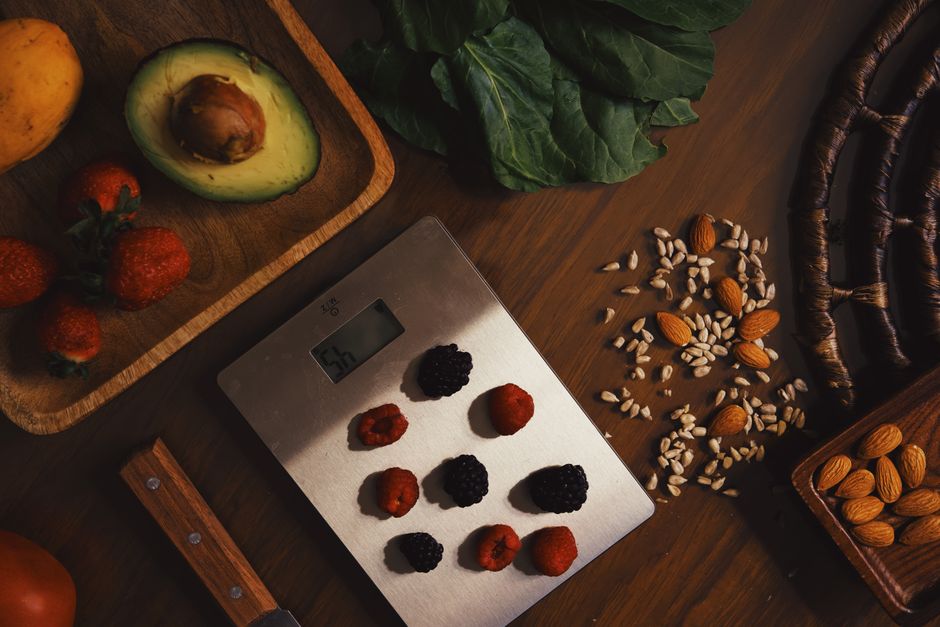
Most women who buy a kitchen scale use it for about two weeks and then it ends up in the utensil drawer — not because weighing food is hard, but because nobody explained what to actually do with the numbers. Weighing your food is one of the few habits that reliably closes the gap between the calories you think you eat and the calories you actually eat. This guide covers how do I weigh my food for weight loss in plain terms: what to weigh, when to weigh it, how to handle restaurant meals, and where the evidence is genuinely thin.
To weigh food for weight loss, put a digital scale on a flat surface, place your plate or container on it, and press tare to reset it to zero. Weigh each food raw when the package label lists a raw weight, and log the grams in an app. Weighing takes about 60 seconds per meal and removes guesswork from portion sizes.
Portion drift is real and it is quiet. A “tablespoon” of peanut butter that heaps over the spoon can carry nearly double the calories of a level one. The same goes for cereal, rice, and cooking oil. None of these errors feel like overeating in the moment, which is exactly why they add up.
What most search results skip is the honest part. Weighing food does not burn fat by itself, and it can become a source of stress if you let it run your day. The goal here is a tool you use with intention, not a rulebook that makes every meal feel like a test. You will find specifics on raw versus cooked weights, restaurant meals, and the limits of the evidence below.
Key Points at a Glance
| Point | What It Means | Why It Matters |
|---|---|---|
| Weigh raw, not cooked, when possible | Package labels list raw weight. Cooking adds or removes water, which changes the weight but not the calories. | Weighing cooked rice or pasta against a raw label figure can throw your count off by 50 percent or more. |
| Tare the plate, not the food | Place your plate on the scale, press tare to zero it, then add food. | Saves dishes and keeps the measurement honest. |
| Weigh calorie-dense foods first | Oils, nuts, nut butters, cheese, and grains are where eyeballing fails most. | These foods carry the highest calories per gram, so small errors cost the most. |
| Weighing is a feedback tool, not a rule | Use it to learn portions, then check in periodically rather than weighing every bite forever. | Research suggests self-monitoring helps with weight loss, but rigid tracking can backfire for some people. |
| Restaurant meals are estimates | You cannot weigh food you did not prepare. Use published nutrition data and accept a wide margin. | Restaurant portions often run two to three times a home serving. |
How Do I Weigh My Food Without Making It a Chore?
Start with one meal a day. Breakfast is the easiest place to build the habit because the foods are simple and repeatable. Weigh your oats, your milk, and your nut butter for a week. You will quickly learn what a real serving looks like, and that knowledge sticks even on days you skip the scale.
A basic digital kitchen scale runs about $15 to $25 and measures in grams and ounces. Look for one with a tare button and a flat platform. I keep mine on the counter next to the cutting board — when it lives in a drawer, it stops getting used.
Log the grams in an app rather than doing math in your head. Most apps let you scan a barcode and enter weight in grams, which takes seconds. The logging matters more than the scale — research on self-monitoring consistently links consistent food tracking with better weight loss results.
Should You Weigh Food Raw or Cooked?
Weigh raw whenever the nutrition label gives a raw weight. That is the number the manufacturer measured, so it is the number that matches your food. A cup of dry rice and a cup of cooked rice are wildly different amounts of food and calories.
Cooked weight is fine when you are weighing a portion off a finished dish, but use a nutrition database entry that specifies cooked weight. The water absorbed during cooking can nearly triple the weight of pasta or rice. If you weigh cooked rice against a raw label figure, your calorie count will be far too low.
How Do I Weigh My Food When Eating Out or On the Go?
You do not. And that is fine. Weighing food is a home-kitchen habit. At restaurants, use the menu’s published calorie ranges and add a buffer of roughly 20 percent, since kitchen portions vary and cooking oil is hard to account for.
Some women carry a small pocket scale for packed lunches or office meals. That works if it feels neutral to you. If it starts to feel like a source of anxiety, put it away. The point of tracking is information, not control.
For travel and social meals, estimate and move on. One estimated meal will not derail a week of consistent eating. The pattern across weeks is what moves the number on the scale, not any single lunch.
Does Weighing Food Actually Help With Weight Loss?
Evidence indicates that people who track their food intake lose more weight than those who do not. A widely cited behavioral study found that participants who logged their food consistently lost more weight than those who logged inconsistently. Weighing food makes those logs more accurate.
But the evidence on rigid tracking is mixed. Some research suggests that for people with a history of disordered eating, detailed food monitoring can increase fixation and stress around food. If weighing food starts to feel compulsive, or if you find yourself avoiding social meals because you cannot weigh the food, that is a signal to step back and talk to a clinician.
Weighing also pairs well with knowing your energy needs. You can estimate your daily calorie burn with the TDEE calculator to see what your target actually is. A deficit of roughly 250 to 500 calories a day is the range most clinical guidance supports for steady weight loss — anything below 1,200 calories a day for women is a clinical minimum that requires medical supervision.
Related Articles
Frequently Asked Questions
Do I need a food scale to lose weight?
No, a scale is a tool, not a requirement. Many people lose weight using measuring cups and consistent portion habits, though a scale is more accurate for calorie-dense foods like oils and nut butters.
Should I weigh my food before or after cooking?
Weigh raw whenever the nutrition label lists a raw weight, because that is what the manufacturer measured. If you weigh cooked food, use a cooked-weight entry in your tracking app.
How accurate is eyeballing portion sizes?
Research on portion estimation shows people routinely under-guess calories, often by 20 to 40 percent on larger or mixed meals. Accuracy improves most for calorie-dense foods when you use a scale.
Does weighing food every day become unhealthy?
For some people, yes — rigid tracking can increase anxiety and food fixation, particularly with a history of disordered eating. If weighing food starts to feel compulsive or disrupts social eating, step back and speak with a clinician.
How do I weigh food without a scale?
Use measuring cups and spoons for liquids and grains, and compare portions to familiar references like a deck of cards for meat. These methods are less precise than a scale but workable for lower-calorie foods.
How many calories should I eat to lose weight?
Most clinical guidance supports a daily deficit of roughly 250 to 500 calories below your maintenance needs. Women should not go below 1,200 calories a day without medical supervision.

The TDEECAL Team writes about nutrition, metabolism, and fat loss the way we built our calculator, with real numbers and no hype. We dig into the research so you don’t have to guess.