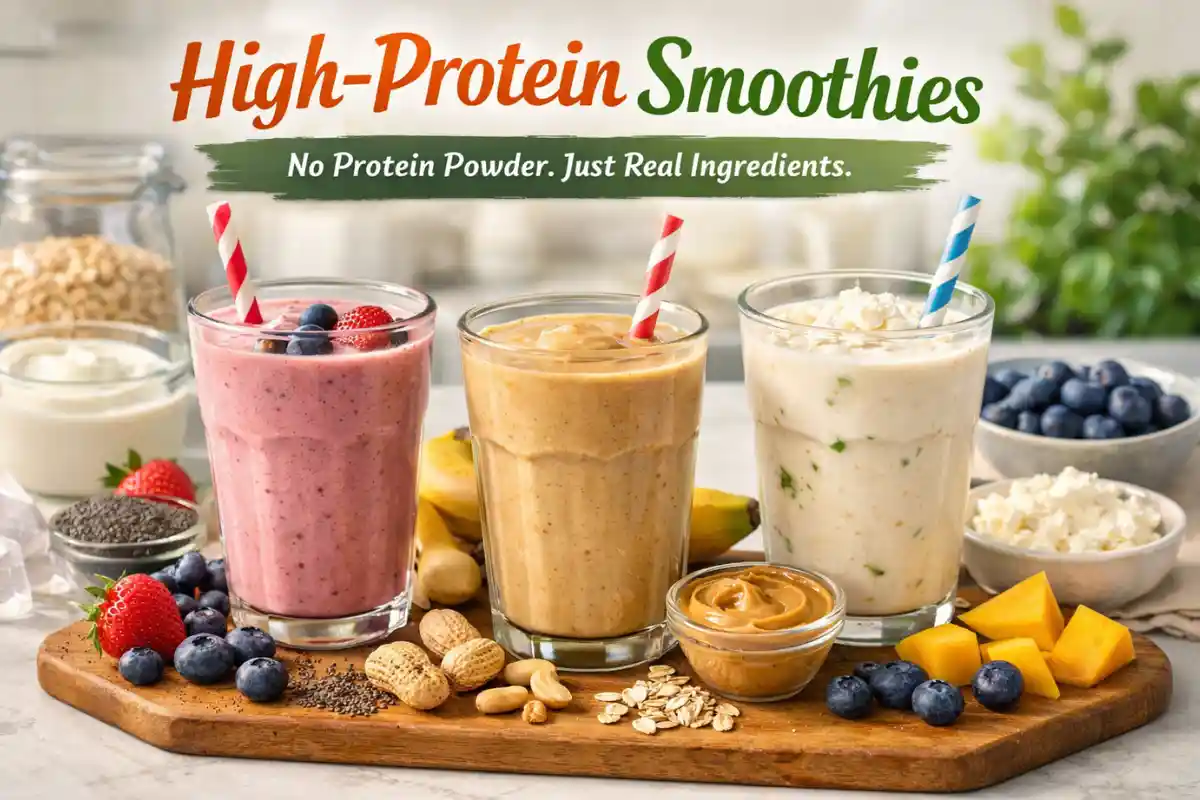
3 High-Protein Smoothies Recipes Without Protein Powder. Easy & Simple!

High-Protein Smoothies Recipes don’t need protein powder. That idea mostly comes from fitness marketing, not actual nutrition science. If your total daily protein is high enough, the source matters far less than people think.

After 35, this becomes more important. Muscle mass slowly declines, and appetite signals become less reliable. Protein helps you stay full longer and maintain muscle, but only if you consistently hit your daily intake. Most people don’t even come close.

A well-built smoothie can fix that gap. But most smoothies fail because they are built around fruit first, not protein.

FieldDetails
What it isSmoothies built with whole food protein sources like yogurt, milk, and nuts
What people claimProtein powder is required to make smoothies effective
What research saysEvidence shows that total protein intake matters more than source
Biggest benefitEasy way to reach 25–35g protein in one meal
Biggest limitationPoor ingredient choices turn smoothies into high-sugar drinks
Best forAdults who want quick meals without cooking
Be careful ifYou add too many calorie-dense ingredients like nut butter
Bottom lineYou don’t need protein powder to make smoothies work. You need enough protein per serving and a better ingredient structure. Most people fail because they build smoothies around taste, not nutrition.

What are high-protein smoothie recipes without protein powder?

They are smoothies that rely on real food to deliver meaningful protein, not supplements. The base usually includes Greek yogurt, milk, cottage cheese, or a combination of these. Nuts, seeds, and oats are often added to increase both protein and calorie density.

The key difference is intention. A typical smoothie is built for taste and convenience, which leads to low protein and high sugar. A high-protein smoothie is built to function as a real meal, meaning it must deliver at least 20–30 grams of protein to be effective.

Research supports this approach. A 2015 review published in The American Journal of Clinical Nutrition found that muscle maintenance depends on total daily protein intake, not whether it comes from whole food or supplements. In simple terms, your body does not care if protein comes from a scoop or from yogurt, as long as you get enough.

Recipe 1: Greek Yogurt Berry Smoothie

High Protein Smoothie • No Powder • Ready in 3 Minutes

Prep: 3 mins Total: 3 mins Serves: 1 Calories: ~280 Protein: ~27g

This smoothie is built around protein first. That’s why it actually keeps you full for hours instead of spiking hunger like typical fruit-heavy smoothies.

Nutrition Facts
Serving Size: 1 smoothie
Calories 280
Total Fat 10g
Carbohydrates 20g
Fiber 5g
Sugar 12g
Protein 27g

Why This Works

Greek yogurt provides slow-digesting protein. Chia seeds add fiber that slows digestion even more. This keeps you full longer and reduces cravings later.

Best For

Ideal for breakfast or quick lunch. Especially useful if you get hungry again within 2–3 hours after eating.

Ingredients

  • 1 cup Greek yogurt (thick, high protein)
  • ½ cup milk (dairy or unsweetened almond)
  • ½ cup berries (blueberries or strawberries)
  • 1 tbsp chia seeds
  • Ice cubes (optional)

Instructions

  1. Add yogurt and milk to blender first.
  2. Add berries and chia seeds.
  3. Blend for 30–45 seconds until smooth.
  4. Add ice if needed and blend again briefly.
  5. Serve immediately.

Pro Tips

  • Use Greek yogurt, not regular yogurt.
  • Keep fruit controlled to avoid sugar overload.
  • Increase yogurt for higher protein.
`);printWindow.document.close(); printWindow.focus(); printWindow.print(); }
Greek Yogurt Berry Smoothie

Recipe 2: Peanut Butter Banana Smoothie

High Protein Smoothie • No Powder • Filling & Energy Dense

Prep: 3 mins Total: 3 mins Serves: 1 Calories: ~420 Protein: ~30g

This smoothie is heavier and more filling than most. It combines protein, fats, and slow carbs, which helps control hunger for longer periods.

Nutrition Facts
Serving Size: 1 smoothie
Calories 420
Total Fat 18g
Carbohydrates 35g
Fiber 5g
Sugar 18g
Protein 30g

Why This Works

Milk provides protein, while peanut butter adds fats that slow digestion. This combination helps keep energy stable and prevents quick hunger spikes.

Best For

Ideal if you skip meals or feel hungry quickly after eating. Works well as a meal replacement, not just a snack.

Ingredients

  • 1 cup milk (dairy preferred for higher protein)
  • 2 tbsp peanut butter
  • 1 medium banana
  • 2 tbsp oats
  • Ice cubes (optional)

Instructions

  1. Add milk first into blender.
  2. Add peanut butter, banana, and oats.
  3. Blend for 30–45 seconds until smooth.
  4. Add ice if needed and blend again.
  5. Serve immediately.

Pro Tips

  • Use natural peanut butter for better nutrition.
  • Don’t add extra sweeteners. Banana is enough.
  • If calories are too high, reduce peanut butter to 1 tbsp.
`);printWindow.document.close(); printWindow.focus(); printWindow.print(); }
Peanut Butter Banana Smoothie

Recipe 3: Cottage Cheese Smoothie

High Protein Smoothie • No Powder • Creamy & Filling

Prep: 3 mins Total: 3 mins Serves: 1 Calories: ~310 Protein: ~28g

This smoothie uses cottage cheese as the protein base. It blends smooth and gives a slower-digesting protein that helps you stay full longer.

Nutrition Facts
Serving Size: 1 smoothie
Calories 310
Total Fat 9g
Carbohydrates 24g
Fiber 3g
Sugar 14g
Protein 28g

Why This Works

Cottage cheese provides casein protein, which digests slowly. This helps control hunger longer compared to fast-digesting smoothies.

Best For

Great if you get hungry quickly after meals. Works well as a breakfast or light dinner option.

Ingredients

  • ½ cup cottage cheese
  • 1 cup milk (dairy or unsweetened almond)
  • ½ cup fruit (berries or mango)
  • Ice cubes (optional)

Instructions

  1. Add milk and cottage cheese to blender first.
  2. Add fruit and ice.
  3. Blend for 30–45 seconds until smooth.
  4. Check texture and blend again if needed.
  5. Serve immediately.

Pro Tips

  • Blend longer than usual for smoother texture.
  • Use berries to keep sugar lower.
  • Add chia seeds if you want more fiber.
`);printWindow.document.close(); printWindow.focus(); printWindow.print(); }
Cottage Cheese Smoothie

How much protein should a smoothie have to actually work?

A smoothie needs at least 20 grams of protein to be meaningful, and closer to 25–35 grams if it replaces a meal. Anything below that is unlikely to keep you full for more than a couple of hours.

This isn’t guesswork. A 2018 study in The Journal of Nutrition showed that higher protein intake helps preserve muscle mass in older adults. This becomes more relevant with age, especially after 35, when muscle loss accelerates.

Most people build smoothies with 8–12 grams of protein and assume they are eating “healthy.” In reality, they are just drinking calories without solving hunger.

Are high-protein smoothies actually good for weight loss?

Yes, but only if they replace something worse. A high-protein smoothie may help you lose weight because it keeps you full longer, which reduces overall calorie intake across the day.

A 2019 study in Nutrients found that higher protein meals reduce hunger and lower later calorie intake. This effect applies to smoothies as long as the protein content is high enough.

However, this is where people get it wrong. If you add a smoothie on top of your normal diet, you will gain weight. If you replace a low-protein meal with a high-protein smoothie, you may lose weight.

The smoothie itself isn’t magic. It’s how you use it.

Why do most smoothies fail to keep you full?

Because they are built incorrectly. Most smoothies are based on fruit, juice, or flavored milk, with little attention to protein content.

This leads to a fast-digesting drink that spikes energy briefly and then drops it. Hunger returns quickly, often within 1–2 hours. That’s when snacking starts.

A functional smoothie always starts with a protein base. Greek yogurt, milk, or cottage cheese should be the foundation. Everything else comes after that.

If you reverse that order, the smoothie fails.

Can smoothies replace meals after 35?

Yes, but only if they meet basic nutritional requirements. A smoothie with 25–35 grams of protein, some fats, and moderate carbs can replace a meal effectively.

Anything below that is just a snack.

There is still one limitation. Research hasn’t fully settled whether liquid meals provide the same long-term fullness as solid food. Short-term studies show they can reduce hunger, but long-term results are mixed.

So while smoothies are useful, they shouldn’t replace every meal in your day.

What is the simplest way to fix your smoothie today?

Start with protein first and build around it. This one change solves most problems.

Instead of asking “what fruit should I add,” ask “where is my protein coming from?” Once that is clear, the rest becomes easy.

This is the difference between a smoothie that works and one that doesn’t.

FAQs On High-Protein Smoothies Recipes

High-protein smoothie recipes without protein powder — do they work?

Yes, they work if the smoothie contains enough protein from real foods like yogurt or milk. Total protein intake across the day matters more than using supplements.

What is the best protein source for smoothies without powder?

Greek yogurt is the most practical option. Cottage cheese and milk are also strong choices and easy to use.

Can I lose weight with high-protein smoothies?

Yes, if the smoothie replaces a lower-quality meal. It may help reduce hunger and lower overall calorie intake.

How much protein should a smoothie have?

At least 20 grams, but ideally 25–35 grams if it replaces a full meal.

Are fruit smoothies high in protein?

No, most fruit smoothies are low in protein unless you add ingredients like yogurt, milk, or nuts.

Final Take

High-Protein Smoothies Recipes don’t need protein powder. That’s not where the problem is.

The real issue is poor structure and low total protein intake. Fix that, and smoothies become one of the easiest ways to stay full, maintain muscle, and control your diet.

Leave a Comment