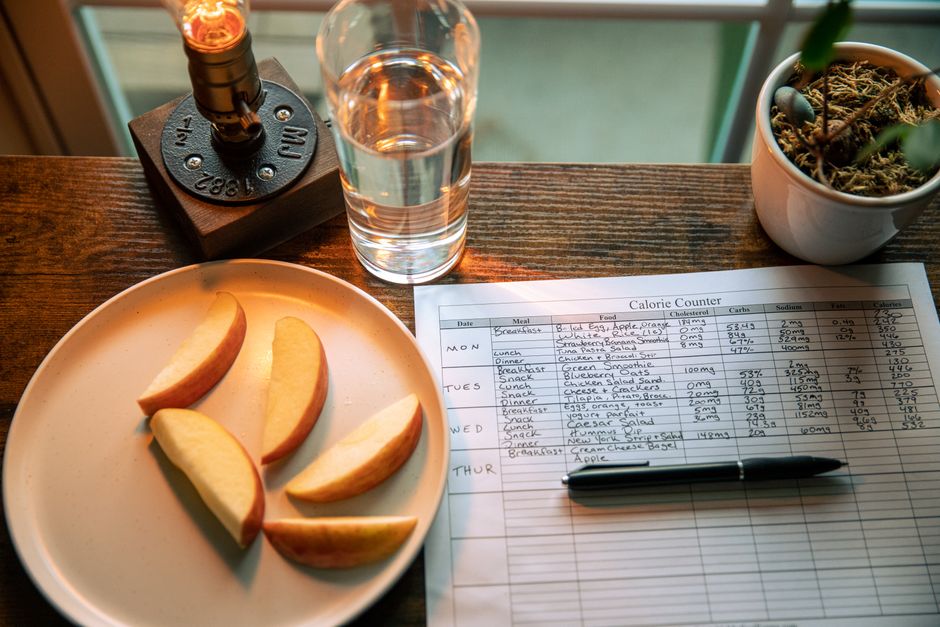
Most women who stall on the scale aren’t eating too much — they’re guessing. A 2019 survey of American adults found that fewer than 1 in 5 could accurately estimate the calories in a typical restaurant meal, and most underestimated by 200 calories or more.
To answer the core question directly: how much calories take in a day for weight loss depends on your body size, age, and activity level, but most women aged 35–65 lose weight at roughly 1,400 to 1,700 calories per day. That range reflects a moderate deficit of about 300 to 500 calories below your total daily energy expenditure (TDEE). Anyone eating below 1,200 calories should do so only under medical supervision.
The problem is that “eat less” advice is everywhere, but almost none of it accounts for the fact that your calorie needs change after 35. Muscle mass declines slowly, hormones shift, and the number that worked at 28 often doesn’t work at 45.
This article gives you the real numbers, the math behind them, and the honest limits of calorie counting. It also covers what the evidence actually says about why the scale stalls — and what to do about it.
Key Points at a Glance
| Point | What It Means | Why It Matters |
|---|---|---|
| Calorie needs vary widely | Women aged 35–65 typically need 1,600–2,200 calories per day to maintain weight | A deficit of 300–500 calories below this range supports gradual loss |
| TDEE is the starting point | TDEE = calories burned through basic function, digestion, and activity | Eating below TDEE creates the deficit that drives weight loss |
| 1,200 calories is a floor, not a goal | Clinical guidance treats 1,200 calories as a minimum for women, not a target | Eating below this without supervision risks muscle loss and nutrient gaps |
| Protein and strength training protect muscle | Higher protein intake and resistance exercise reduce muscle loss during a deficit | Preserving muscle keeps your metabolism higher over time |
| Tracking has limits | Food labels can be off by 10–20%, and activity trackers overestimate burn | Use tracking as a guide, not a precise instrument |
How Do You Calculate How Much Calories Take in a Day for Weight Loss?
Start with your TDEE, then subtract 300 to 500 calories. Research consistently shows that a deficit in this range produces steady loss of about 0.5 to 1 pound per week — a rate that protects lean muscle better than aggressive restriction. You can estimate your TDEE using a TDEE calculator that factors in age, weight, height, and activity level.
The formula most calculators use is the Mifflin-St Jeor equation, which research has found to be among the more accurate predictive equations for resting energy expenditure. It’s not exact — individual variation is real — but it gives you a defensible starting point rather than a guess.
Why Do Calorie Needs Change After 35?
Resting metabolic rate declines by roughly 1–2% per decade after age 20, largely because of gradual muscle loss. Research published in the American Journal of Clinical Nutrition found that fat-free mass is the strongest predictor of resting energy expenditure — so when muscle drops, calorie needs drop with it. This is why the same diet that worked at 30 can stall at 45.
Menopause adds another layer. Some studies suggest that the drop in estrogen contributes to shifts in fat distribution and a modest decline in energy expenditure, though the evidence is mixed on how much of the change is hormonal versus simply aging and reduced activity. The honest answer: both matter, and neither is fully within your control.
How Low Should You Go — and What’s the Floor?
Clinical guidance generally treats 1,200 calories per day as the minimum for women without medical supervision. Below that, it becomes difficult to meet basic nutrient needs — and the risk of muscle loss, fatigue, and nutrient deficiencies rises. Very-low-calorie diets exist, but they require medical oversight and are not a do-it-yourself approach.
For most women in this age range, a target between 1,400 and 1,700 calories supports steady loss without excessive hunger. If that number feels low, the better move is usually to increase activity rather than cut food further. Adding 2,000 to 3,000 steps per day can shift the math meaningfully without pushing intake into a range that’s hard to sustain.
Why the Scale Stalls Even When You’re Doing Everything Right
Water weight, hormonal fluctuations, and inaccurate tracking all mask real progress. Some research suggests people underestimate their intake by 20–30% on average, often without realizing it — portions, cooking oils, and small bites add up. And activity trackers tend to overestimate calories burned, which can quietly erase a deficit.
The scale also lies in the short term. A high-sodium meal, a hard workout, or the week before your period can add 2–4 pounds of water that has nothing to do with fat. Evidence indicates that weight loss is rarely linear, even when adherence is high. Judge progress over four to six weeks, not day to day.
Does the Type of Calories Matter?
For weight loss, total calories drive the outcome — but food quality affects how hard the deficit is to stick to. Protein and fiber increase satiety, which makes a 400-calorie deficit feel manageable rather than miserable. Research published in the American Journal of Clinical Nutrition has found that higher-protein diets support better appetite control and lean mass retention during weight loss.
That said, no single macronutrient split has been shown to produce meaningfully more fat loss when calories are matched. The best approach is the one you can maintain. If a higher-protein, moderate-carb pattern keeps you full and consistent, it wins on adherence alone.
Related Articles
Frequently Asked Questions
How many calories should a 50-year-old woman eat to lose weight?
Most women aged 50 need roughly 1,400 to 1,600 calories per day to lose about a pound per week, depending on activity level and starting weight. A TDEE calculator gives a more personalized estimate.
Is 1,200 calories a day enough to lose weight safely?
1,200 calories is generally considered the minimum for women without medical supervision, not a recommended target. Eating at this level long-term raises the risk of nutrient gaps and muscle loss.
Why am I not losing weight on 1,500 calories a day?
Common causes include underestimated intake, overestimated exercise burn, water retention, and normal plateaus that can last two to three weeks. Checking portion accuracy and averaging weight over a month usually clarifies what’s happening.
How much calories take in a day if I exercise?
Exercise raises your daily calorie needs, so you can eat somewhat more and still be in a deficit. Be cautious with adding back calories — trackers often overestimate burn by 20–30%.
Should I eat back the calories I burn during exercise?
Eating back roughly half of estimated exercise calories is a reasonable middle ground for most people. Eating back the full amount often erases the deficit.
How long does it take to see results at a 500-calorie deficit?
A 500-calorie daily deficit typically produces about 1 pound of loss per week, though water weight and hormonal shifts make week-to-week numbers uneven. Judge results over four to six weeks.

The TDEECAL Team writes about nutrition, metabolism, and fat loss the way we built our calculator, with real numbers and no hype. We dig into the research so you don’t have to guess.