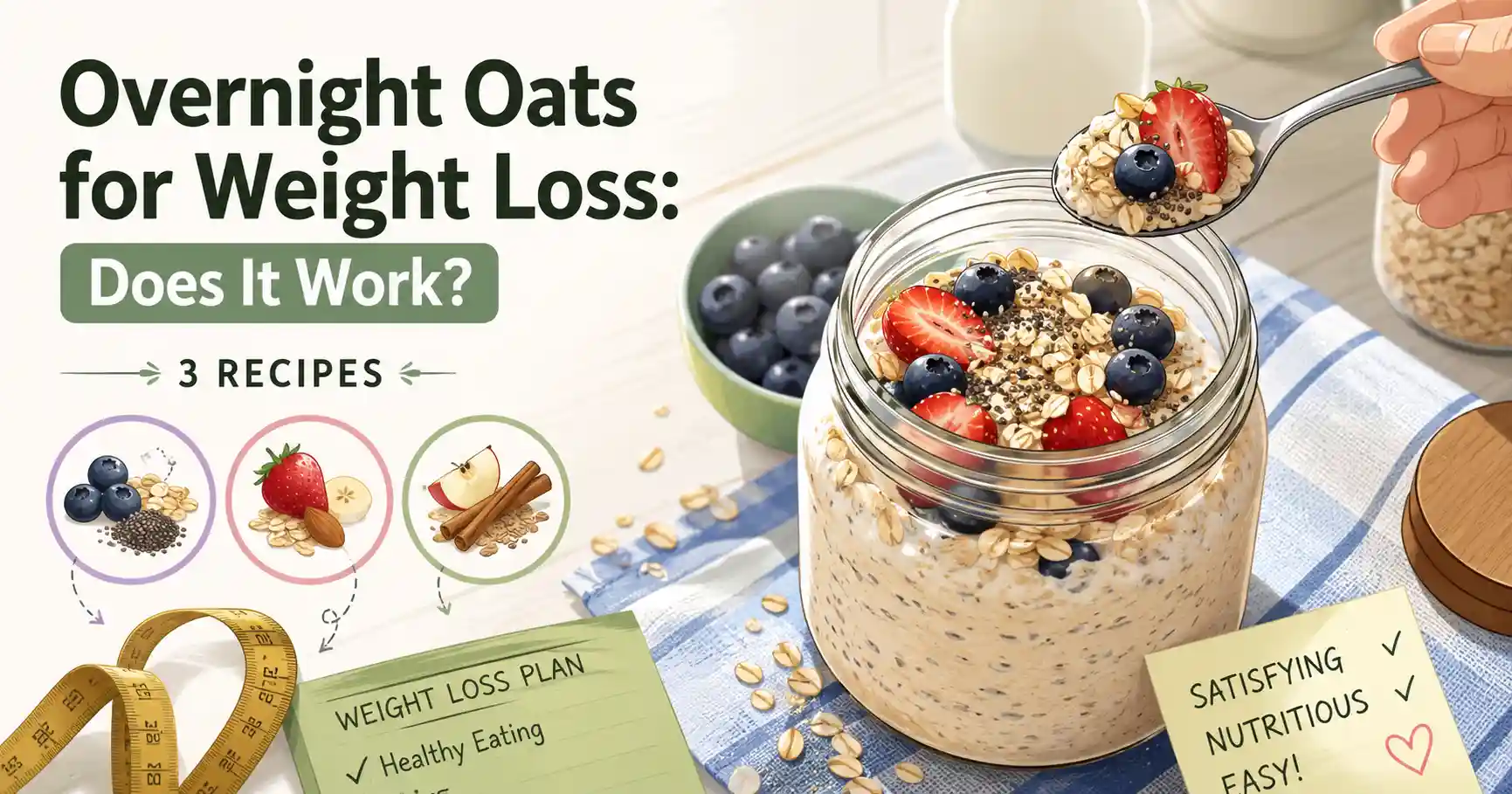
Most breakfasts leave you reaching for a snack before lunch. Overnight oats usually don’t.
Overnight oats for weight loss work because rolled oats are high in beta-glucan fiber, which slows digestion and suppresses hunger hormones for two to four hours after eating. A standard jar runs 300–420 calories, takes under ten minutes to prepare, and is ready the moment you open the fridge in the morning. The oats themselves aren’t magic — what matters is how you build the jar.
This article explains why overnight oats can support weight loss, answers the best-time question directly, and gives you three ready-to-make recipes: a base version with chia seeds and Greek yogurt, a flat-stomach variation, and a dairy-free classic. All three have calorie counts included.
If you’ve made overnight oats before and found them unsatisfying, the issue is almost always low protein. That’s the most common reason people feel hungry again by 10 a.m. — and it’s an easy fix.
Overnight Oats for Weight Loss: Base Recipe (Chia Seeds & Greek Yogurt)
Ingredients
- ½ cup rolled oats (old-fashioned, not instant)
- ½ cup unsweetened almond milk (or low-fat dairy milk)
- ¼ cup plain nonfat Greek yogurt
- 1 tbsp chia seeds
- 1 tsp honey (optional — omit to save ~20 calories)
- ¼ tsp vanilla extract
- ¼ tsp ground cinnamon
- ¼ cup fresh blueberries or raspberries (topping, add in the morning)
Instructions
- Add the rolled oats, chia seeds, and cinnamon to a mason jar or any container with a tight-fitting lid. Give them a brief stir so the chia seeds are distributed evenly.Tip: Wide-mouth mason jars are the most practical option here — they’re easy to stir, store, and eat directly from. No extra bowl required.
- Pour in the almond milk, then add the Greek yogurt and vanilla extract. Stir until the yogurt is fully incorporated. It tends to sit at the bottom if you leave it unstirred.
- Sweeten with honey if you’re using it. Stir once more, then seal the jar.Tip: If you skip the sweetener entirely, add a few extra berries in the morning — their natural sugar is enough for most people once the oats have softened.
- Refrigerate for at least 6 hours. Overnight is ideal — the oats absorb the liquid and develop a creamy, pudding-like texture.
- Check consistency in the morning. If the oats feel too thick, stir in 1–2 tbsp of extra milk.Tip: Overnight oats keep for up to 5 days in the fridge, so you can prep a full week of jars on Sunday night.
- Top with fresh berries and eat cold. Or microwave with the lid off for 60–90 seconds, stirring halfway, if you prefer them warm.
Why Overnight Oats Work for Weight Loss
The main mechanism is fiber — specifically beta-glucan, which oats contain in higher amounts than most everyday foods. When beta-glucan absorbs liquid during overnight soaking, it forms a thick gel in your stomach. That gel slows how fast your stomach empties, keeping you fuller longer and keeping hunger hormones quieter. According to research indexed by the National Institutes of Health on beta-glucan and satiety hormones, higher beta-glucan intake is associated with meaningfully elevated levels of PYY — a hormone that signals fullness — for two to four hours after eating.
There’s also the resistant starch factor. Uncooked, soaked oats contain starch that your digestive enzymes can’t fully break down. It passes through largely intact and feeds gut bacteria instead of spiking blood sugar. Cooking oats on the stove breaks down this starch — soaking them cold preserves it. That’s a modest but genuine metabolic edge over a hot bowl of oatmeal.
Rolled oats also have a low glycemic index, meaning blood sugar rises gradually rather than spiking and crashing. Harvard T.H. Chan School of Public Health explains how low-glycemic foods affect fat storage and hunger cycles — and slow-digesting carbohydrates consistently perform better for appetite control than processed, high-GI options. I always use rolled oats specifically for this reason; quick oats soaked overnight turn mushy and their glycemic advantage largely disappears.
For context on where oats fit among other high-fiber breakfast choices, our guide to the top fiber-rich foods for weight loss has a useful side-by-side breakdown.
The Best Time to Eat Overnight Oats for Weight Loss
The answer is morning, as your first meal. Eating a fiber-and-protein-rich breakfast early helps regulate blood sugar through the late morning and early afternoon — the hours when most people make impulsive snack choices. The satiety window from beta-glucan runs two to four hours, so timing that window to overlap with your highest-temptation period makes practical sense.
What about eating overnight oats at night? It won’t derail you if the calories fit your daily total. But the hunger-suppression benefit is largely wasted when you’re about to sleep. You’re not fighting food cravings at midnight. The most useful application of overnight oats is taming the late-morning and pre-lunch hunger window, and that only works if you eat them in the morning.
The convenience angle matters more than people give it credit for. A breakfast that’s already sitting in your fridge — portioned, prepped, ready to eat — is one you’ll actually consume consistently. And consistency is what produces results, not any individual food.
Nutrition Facts — Base Recipe (Per Jar)
1 serving · with almond milk, nonfat Greek yogurt, 1 tsp honey, ¼ cup blueberries
Estimates calculated using USDA FoodData Central. Values vary by brand, milk type, and toppings.
What to Add — and What to Skip — for Weight Loss Results
Building overnight oats for weight loss means being deliberate about every ingredient you add to the jar. The base recipe is well-calibrated. Here’s how to adjust it without tipping the calorie balance.
| Original Ingredient | Swap | Why It Works |
|---|---|---|
| Greek yogurt (dairy) | Silken tofu, blended (¼ cup) | Dairy-free; similar protein (~8g), creamy texture when blended smooth |
| Honey | Omit, or use ½ mashed ripe banana | Saves 20 calories; banana adds natural sweetness and potassium |
| Fresh berries | Frozen berries, thawed overnight in the jar | Budget-friendly; frozen often contain higher antioxidant levels than out-of-season fresh |
| Rolled oats | Quick oats (only if rolled are unavailable) | Faster to soften, but higher glycemic index and mushier texture after soaking |
| Almond milk | Unsweetened soy milk | Adds ~4g more protein per serving; closest to dairy milk nutritionally |
| Chia seeds | Ground flaxseed (1 tbsp) | Similar fiber and omega-3 profile; flax must be ground to absorb properly |
What to limit: granola (typically 120–150 calories per ¼ cup), nut butters beyond 1 tablespoon, flavored yogurts with added sugar, and full-fat coconut milk. These are the ingredients that push a 350-calorie jar to 650 without it registering as a large meal.
The chia seeds are worth keeping as a regular addition. Our full guide on how chia seeds support weight loss explains the mechanism in more detail if you want the deeper breakdown.
2 More Overnight Oats Recipes for Weight Loss
1. Flat Stomach Overnight Oats (Anti-Bloat Variation)
Flat Stomach Overnight Oats
This version skips banana — which some people find contributes to bloating — and adds ginger and turmeric. Both are frequently cited for anti-inflammatory properties, though strong clinical evidence for direct bloating reduction in healthy adults remains limited. The flavor is mild and slightly earthy. Blueberries on top keep it from tasting medicinal.
Ingredients:
- ½ cup rolled oats
- ½ cup unsweetened almond milk
- ¼ cup plain nonfat Greek yogurt
- 1 tbsp chia seeds
- ½ tsp ground ginger
- ¼ tsp ground turmeric
- 1 tsp fresh lemon juice
- ¼ cup blueberries (add in the morning)
Method: Combine all ingredients except blueberries in a jar. Stir until evenly mixed. Seal and refrigerate overnight. Add blueberries in the morning and eat cold.
Note: The turmeric will tint your oats yellow — that’s normal and fades slightly after mixing.
2. Dairy-Free Classic Overnight Oats
Dairy-Free Classic Overnight Oats
No yogurt, no dairy. The almond butter adds protein and healthy fat that makes the jar genuinely filling. This version keeps well for the full five-day fridge window and actually tastes better by day two — the almond butter flavor mellows and blends with the oats overnight oats recipe for weight loss flavor profile better than on day one.
Ingredients:
- ½ cup rolled oats
- ¾ cup unsweetened oat milk
- 1 tbsp chia seeds
- 1 tbsp natural almond butter (no added sugar)
- 1 tsp maple syrup
- ½ tsp cinnamon
- ¼ cup sliced banana (add in the morning)
Method: Combine oats, chia seeds, and cinnamon. Add oat milk, almond butter, and maple syrup. Stir until the almond butter is fully distributed — it takes about 30 seconds of consistent stirring. Seal and refrigerate overnight. Slice banana on top in the morning.
Tip: Use a fork rather than a spoon to work the almond butter in — it incorporates faster.
If you want to rotate overnight oats with other quick morning options, our list of weight-loss smoothie recipes covers high-protein blends that work on mornings when you want something cold and drinkable instead.
Storage and Make-Ahead Tips
- Fridge shelf life: Up to 5 days in a sealed jar or airtight container. The texture softens a little more each day — most people find days 2–3 have the best consistency.
- Freezer: Not recommended for the complete jar. Greek yogurt and fresh fruit don’t freeze well and separate on thawing. You can batch-freeze the dry mix (oats + chia seeds + spices) in small bags, then add wet ingredients the night before.
- Reheating: Remove the lid and microwave for 60–90 seconds, stirring halfway through. Stir in a splash of milk after warming if the texture tightens up — it will.
- Batch prep tip: Line up 4–5 jars on Sunday evening. Add dry ingredients first to each jar, then wet ingredients, so you can confirm each jar is consistent before sealing. Add fresh fruit toppings the morning of.
- On the go: Wide-mouth mason jars with plastic lids travel well in a bag. No bowl needed — eat directly from the jar.
Frequently Asked Questions
Are overnight oats good for weight loss at night?
Overnight oats can be eaten at night without causing weight gain, but the satiety benefit is less useful then. The fiber and protein in overnight oats help suppress appetite during the day — hours when you’re most likely to overeat. Eating them as a late-night snack uses those calories without taking advantage of their main benefit. If your daily calorie total fits, it’s fine. But as a breakfast, they’re considerably more effective for weight management.
What is the best time to eat overnight oats for weight loss?
Morning is the best time to eat overnight oats for weight loss. Eating them as your first meal helps regulate blood sugar and keeps hunger manageable through the late morning and early afternoon. Research on beta-glucan — the primary fiber in oats — shows the satiety effect lasts two to four hours after eating, which covers the window when many people make impulsive food decisions. Having them prepped in the fridge also removes any barrier to eating a proper breakfast.
Do overnight oats cause weight gain?
Overnight oats don’t inherently cause weight gain, but they can contribute to one if portions are loose. A simple jar of oats, milk, and chia seeds runs around 300–400 calories. Add generous peanut butter, granola, chocolate chips, or sweetened flavored yogurt, and a single jar can easily reach 600–700 calories without looking noticeably larger. The oats themselves are well-calibrated for breakfast — the toppings are where most people overshoot. Measure your add-ins at least for the first few weeks.
Are overnight oats with chia seeds good for weight loss?
Yes. Overnight oats with chia seeds are a particularly effective combination for weight loss because chia seeds expand significantly when hydrated, adding physical volume without many extra calories. One tablespoon adds roughly 60 calories along with nearly 5 grams of fiber and 2 grams of protein. That extra fiber increases the total satiety effect of the jar. The texture also improves — the chia creates a thicker, pudding-like consistency that feels more substantial than plain oats soaked in milk.
How many calories should overnight oats have for weight loss?
A target of 300–420 calories per jar works well for most women aiming to lose weight, leaving enough room for balanced lunch, dinner, and snacks within a typical 1,400–1,600 calorie daily intake. The base recipe here — oats, almond milk, nonfat Greek yogurt, chia seeds, honey, and berries — lands at roughly 350 calories and 20 grams of protein. That combination is enough to carry most people to lunch without snacking. If you’re more active or taller, a slightly larger serving is appropriate.
Can I eat overnight oats every day for weight loss?
Eating overnight oats daily is practical and nutritionally sound. According to USDA FoodData Central nutritional data for raw rolled oats, oats provide B vitamins, magnesium, phosphorus, and iron alongside their fiber content. Rotating between variations — the flat stomach version, the dairy-free classic, different seasonal fruit toppings — prevents the habit from feeling repetitive. The main thing to watch over time is portion creep: a small daily overage adds up meaningfully over weeks.
Disclaimer: The recipes and nutritional information on TDEEcal.com are shared for general informational and educational purposes only. They are not a substitute for professional medical or dietary advice, diagnosis, or treatment. Results vary based on individual health, activity level, and overall calorie intake. Always consult a qualified healthcare provider before making significant changes to your diet, especially if you have an existing medical condition or are taking medication.

The TDEECAL Team writes about nutrition, metabolism, and fat loss the way we built our calculator, with real numbers and no hype. We dig into the research so you don’t have to guess.