How Much Oats Should I Eat for Weight Loss
Most people scoop oats into a bowl without measuring, and that habit can quietly add hundreds of extra calories to your day.
The right amount of oats for weight loss is typically 40 to 50 grams dry weight (about half a cup) per serving, which provides roughly 150 to 200 calories before any toppings. This portion fits comfortably into a standard weight-loss calorie budget while still giving you enough fiber and protein to stay full for hours. The exact amount of oats you should eat depends on your total daily calorie needs, your activity level, and what you add to the bowl.
Here is the problem with most oatmeal advice online. It focuses on which type of oats to buy or how to make them taste better, but rarely tells you the actual portion that moves the scale. That missing piece is exactly why so many women eat “healthy” oatmeal every morning and still wonder why weight loss stalls.
This guide covers the serving size that works for weight loss, how to adjust it to your body, and the common mistakes that turn a diet-friendly breakfast into a calorie bomb.
Key Points at a Glance
| Point | What It Means | Why It Matters |
|---|---|---|
| Dry versus cooked weight | Measure oats before cooking, not after | Cooked oats triple in volume, so eyeballing leads to double portions |
| Standard serving size | 40 to 50 grams dry weight (half cup) | Provides 150 to 200 calories with room for toppings |
| Protein needs | Add 15 to 20 grams of protein | Protein keeps you full and preserves muscle while losing fat |
| Topping calories | Limit nuts, seeds, and dried fruit | These add 100 to 300 calories quickly without much volume |
| Adjustment factors | Activity level and total calorie target | Active women may need more; sedentary women may need less |
What Does a Weight Loss Portion of Oats Actually Look Like?
Research consistently shows that portion control is one of the strongest predictors of weight loss success, and oats are no exception. A half cup of dry rolled oats weighs about 40 grams and cooks up to roughly one cup, which looks surprisingly small in a big breakfast bowl.
That visual mismatch is where most people go wrong. You fill a large bowl with cooked oats that looks like a generous meal, but you have actually eaten two or three servings without realizing it. I always weigh my oats on a kitchen scale before cooking — it takes ten seconds and removes all the guesswork.
The calorie math is straightforward. A 40-gram serving of dry oats provides about 150 calories, 5 grams of protein, and 4 grams of fiber. A 50-gram serving bumps that to roughly 190 calories, 6 grams of protein, and 5 grams of fiber.
Both portions work for weight loss, but 40 grams is the safer starting point if you are eating oats daily and adding toppings. Some studies suggest that higher fiber intake from whole grains like oats is linked to lower body weight, but the effect only helps if the total calories still fit your daily target.
Cook’s note: I use a food scale for oats every single morning. The difference between a loose cup and a packed cup of oats is about 20 grams — that is nearly 80 extra calories you did not plan for.
How Much Oats Should I Eat Based on My Calorie Target?
Your personal oat portion should be based on your total daily calorie goal, not a one-size-fits-all number. If you are eating around 1,500 calories per day for weight loss, a 40-gram serving of oats with protein and fruit fits comfortably as a 300 to 350 calorie breakfast.
If your calorie target is higher — say 1,800 to 2,000 calories — you can increase your oats to 50 or even 60 grams dry weight. The key is to keep the bowl proportional to the rest of your day’s intake. Women who are more active or taller typically need more calories and can handle a larger portion.
For women with lower calorie targets around 1,200 to 1,400 calories, stick to 30 to 40 grams of dry oats. This keeps breakfast light enough to leave room for lunch, dinner, and snacks without going over your daily budget. Remember that 1,200 calories is a clinical minimum for women and should only be followed under medical supervision.
The most reliable way to find your number is to use a calorie calculator that factors in your age, height, weight, and activity level. Your oatmeal portion is then simply a percentage of that total — roughly 20 to 25 percent of your daily calories for breakfast.
Calculate your maintenance calories and your weight loss target using the TDEE Calculator before deciding on your portion size.
What Turns a Healthy Oatmeal Bowl Into a Weight Gain Meal?
The oats themselves are rarely the problem. The toppings and cooking method are where oatmeal goes off the rails for weight loss.
One tablespoon of peanut butter adds about 95 calories. A quarter cup of dried cranberries adds 130 calories. A tablespoon of brown sugar adds 50 calories. Two tablespoons of chia seeds add 120 calories. These add-ons stack quickly, turning a 200-calorie bowl into a 500 or 600-calorie meal.
Research published in the Journal of the American Dietetic Association has shown that liquid calories and calorie-dense add-ons are easy to overlook, which is why people underestimate their intake by hundreds of calories daily. The same principle applies to oatmeal toppings — they are easy to sprinkle on generously and forget.
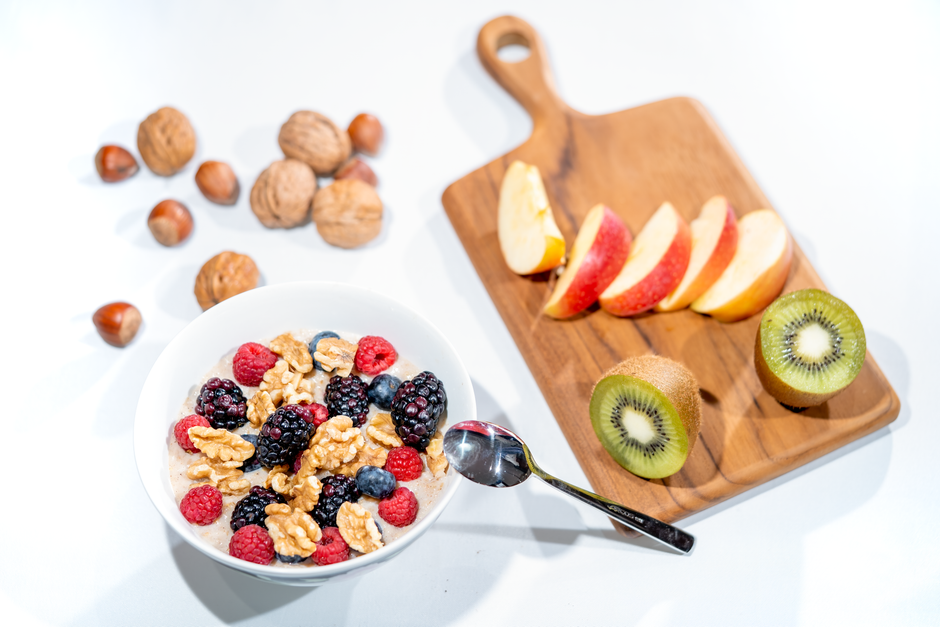
A better approach is to build your bowl with volume and protein first. Use water or unsweetened almond milk instead of whole milk. Add a scoop of vanilla protein powder or a beaten egg white while cooking for extra protein without many calories. Top with fresh berries or a sliced banana instead of dried fruit, and measure nut butters with a spoon rather than pouring.
Cook’s note: I stir a scoop of unflavored protein powder into my oats after cooking. It thickens the texture like a porridge and adds 20 grams of protein without changing the flavor much.
Do Different Types of Oats Change the Portion Size?
The type of oats you buy changes how they cook, but not the calories per gram. Rolled oats, steel-cut oats, and quick oats all contain roughly the same calories per serving — about 150 to 190 calories per 40 to 50 grams dry weight.
Steel-cut oats take longer to cook and have a chewier texture, but they are not inherently better for weight loss than rolled oats. The main difference is glycemic response, with some research suggesting that less processed oats cause a slower blood sugar rise, which may help with appetite control.
Instant oats are the one type to watch. Many flavored instant oat packets contain added sugar and salt, pushing a small serving to 200 calories or more with little protein. Plain instant oats are fine if you measure them, but the flavored versions are easy to overeat because they are designed to taste sweet.
Whatever type you choose, weigh the dry oats before cooking. The cooking method — stovetop, microwave, or overnight soak — does not change the calorie count, but it does change the volume, which can trick your eyes into thinking you are eating more than you are.
Frequently Asked Questions
Related Articles
Is it better to weigh oats dry or after cooking?
Weigh oats dry, before cooking, because the calorie count on the package refers to the dry weight. Cooked oats absorb water and triple in volume, so weighing them after cooking gives you an inaccurate portion that is easy to underestimate.
Can I eat oats every day for weight loss?
Yes, eating oats daily can work well for weight loss as long as your portion fits your calorie target. Oats provide fiber and protein that support fullness, but the total daily calorie intake is what determines whether you lose weight.
How many calories are in half a cup of dry oats?
Half a cup of dry rolled oats weighs about 40 grams and contains roughly 150 calories. This serving provides about 5 grams of protein and 4 grams of fiber before any toppings are added.
What can I add to oatmeal without adding many calories?
Fresh berries, cinnamon, vanilla extract, and unsweetened almond milk add flavor for very few calories. A scoop of protein powder or a beaten egg white adds protein without significantly increasing the calorie count.
Are steel-cut oats better than rolled oats for weight loss?
Steel-cut and rolled oats are similar in calories and fiber, so neither is clearly better for weight loss. Some research suggests steel-cut oats may cause a slower blood sugar rise, which could help with appetite, but the difference is modest.
Why am I not losing weight even though I eat oatmeal every day?
The most common reason is portion distortion — you are likely eating more oats than you think or adding calorie-dense toppings. Measure your dry oats with a scale and track all toppings for a few days to see where the extra calories are coming from.

The TDEECAL Team writes about nutrition, metabolism, and fat loss the way we built our calculator, with real numbers and no hype. We dig into the research so you don’t have to guess.