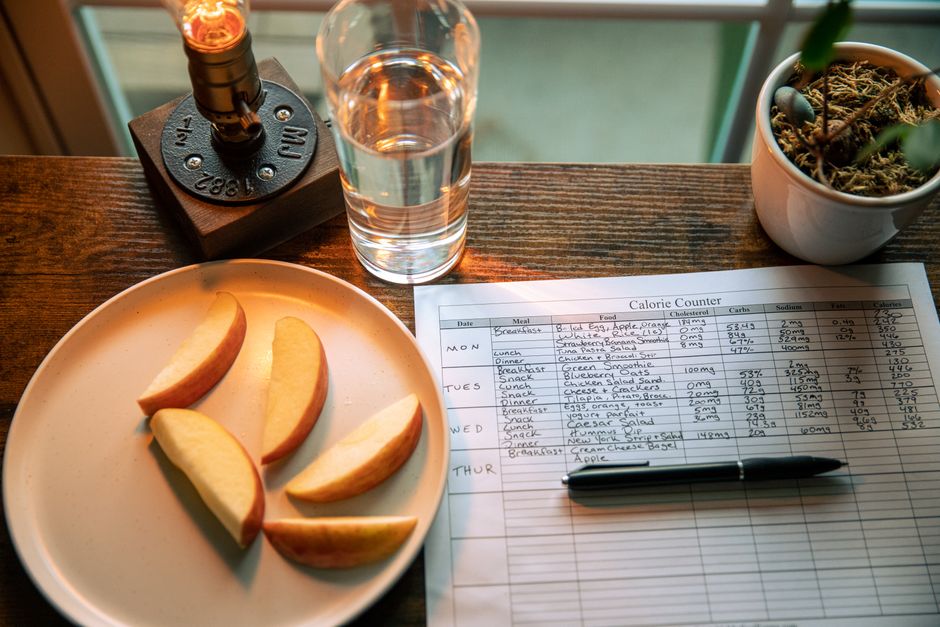
Most women who stall on weight loss aren’t eating too much — they’re guessing. And guessing is the fastest way to spend six weeks doing everything “right” while the scale refuses to move.
So how many calories eat a day for weight loss? Most women aged 35–65 lose weight eating roughly 1,400 to 1,800 calories daily, depending on height, current weight, and activity level. That range comes from subtracting a moderate 300–500 calorie deficit from your estimated maintenance needs. Your exact number depends on your total daily energy expenditure, not a generic chart.
Here’s what most search results skip: your maintenance calories drop as you lose weight. The number that worked at 190 pounds won’t work at 165. That’s not failure — it’s math.
This article covers how to estimate your real number, why the standard formulas run high for women over 35, and what to do when the scale stalls despite honest tracking. No hype. Just the arithmetic that actually drives fat loss.
Key Points at a Glance
| Point | What It Means | Why It Matters |
|---|---|---|
| Typical range: 1,400–1,800 calories | A moderate deficit from estimated maintenance for most women 35–65 | Gives you a realistic starting point instead of an arbitrary low number |
| Deficit of 300–500 calories daily | Roughly 0.5 to 1 pound of fat loss per week | Larger deficits increase muscle loss and make adherence harder |
| 1,200 calories is a floor, not a goal | Below this, nutritional adequacy becomes difficult without medical supervision | Very low intakes risk muscle loss, fatigue, and nutrient gaps |
| Recalculate after 10–15 pounds lost | Maintenance needs fall as body weight drops | Prevents the plateau most people blame on “metabolism” |
How Do You Calculate How Many Calories to Eat a Day for Weight Loss?
Start with your maintenance calories — the amount that keeps your weight stable — then subtract a moderate deficit. You can estimate maintenance with a TDEE calculator, which factors in age, height, weight, and activity. The TDEE calculator at TDEEcal does this in under a minute.
Be honest about your activity level when you enter it. Most people overestimate how much they move. If you have a desk job and walk the dog, that’s “lightly active” — not “moderately active.” Choosing one level too high can add 200–300 phantom calories to your target.
Why Do Standard Calorie Formulas Run High for Women Over 35?
Most calorie equations were built on younger populations. As estrogen declines through perimenopause and menopause, lean muscle mass tends to decrease and fat distribution shifts — both of which lower daily energy needs. Research consistently shows resting metabolic rate declines with age, partly from muscle loss and partly from reduced spontaneous movement.
That doesn’t mean your metabolism is “broken.” It means a 48-year-old woman at 160 pounds typically burns fewer calories at rest than a 28-year-old at the same weight. Formulas that ignore age adjustments can leave you eating 150–200 calories above your true maintenance — enough to erase a modest deficit entirely.
What Does a 1,400–1,800 Calorie Day Actually Look Like?
Numbers on a calculator mean nothing until they hit a plate. A typical day at roughly 1,500 calories might include eggs and toast at breakfast, a turkey sandwich with fruit at lunch, Greek yogurt as a snack, and grilled chicken with rice and vegetables at dinner. Protein at every meal matters — it protects muscle during a deficit and tends to keep you fuller.
Research published in the American Journal of Clinical Nutrition has found that higher protein intakes during weight loss help preserve lean mass. Some studies suggest aiming for roughly 1.2 to 1.6 grams of protein per kilogram of body weight during a deficit, though individual needs vary.
Why Has Your Weight Loss Stalled?
A plateau after losing 10–20 pounds is usually arithmetic, not biology. Your smaller body burns fewer calories, so the deficit that once worked now roughly matches your maintenance. Recalculate your TDEE at your current weight and adjust — often by 100–150 calories, not 500.
Before cutting further, check your tracking for a week. Portion drift is real and gradual. If your intake is genuinely accurate and the scale hasn’t moved in three to four weeks, a small reduction or an increase in daily movement usually restarts progress. No strong clinical evidence supports “metabolism damage” at moderate deficits — but adherence fatigue is very real.
Related Articles
Frequently Asked Questions
How many calories should a 50-year-old woman eat to lose weight?
Most women around age 50 lose weight eating roughly 1,400 to 1,700 calories daily, depending on height, weight, and activity. Use a TDEE calculator with your current stats and subtract 300–500 calories.
Is 1,200 calories a day safe for weight loss?
1,200 calories is generally considered the clinical minimum for women and should only be used with medical supervision. Eating below it without oversight risks muscle loss and nutrient deficiencies.
Why am I not losing weight eating 1,500 calories a day?
Your maintenance calories may have dropped as you lost weight, or your tracking may be drifting by a few hundred calories daily. Recalculate your TDEE at your current weight before cutting lower.
Should I eat back the calories I burn during exercise?
Usually only partially, since exercise calorie estimates tend to run high. If you’re hungry after hard workouts, eating back about half the estimated burn is a reasonable approach.
Does metabolism slow enough with age to block weight loss?
Resting metabolism does decline gradually with age, largely through muscle loss, but it rarely blocks weight loss on its own. A modest deficit and strength training address most of the decline.
How often should I recalculate my calorie target?
Recalculate after every 10 to 15 pounds lost, or whenever the scale stalls for three to four weeks. Your target should shrink as your body weight drops.
Your calorie target isn’t a verdict — it’s a starting estimate you refine with real-world results. Track honestly for two to three weeks, adjust based on what the scale and your energy levels tell you, and recalculate as you go. That feedback loop matters more than any formula.

The TDEECAL Team writes about nutrition, metabolism, and fat loss the way we built our calculator, with real numbers and no hype. We dig into the research so you don’t have to guess.